
Summary
For over 50 years after independence, most sub-Saharan countries struggled to move beyond poverty, unemployment, and economic stagnation. This persistent challenge is not due to a lack of educated people or natural resources — but due to the essential attitudes for social and economic transformation that never took root within African societies.
This blog highlights why these attitudes are missing, how this gap shaped the first five decades of independence, and how EducationAfrica offers a practical pathway to rebuild the mindset needed for transformation.
Introduction
The way sub-Saharan Africa looks today — its borders, official languages, administrative structures, and education systems — is primarily a result of the Berlin Conference of 1884–1885. In just a few meetings in Berlin, Germany, European powers carved the continent into territories and subsequent policies that still define Africa’s geopolitical map.
While the Berlin Conference shaped the Africa we see today, it did not shape the sub Saharan Africa we know today. The sub Saharan Africa we know today is instead a product of something deeper: the long-term shaping of African societies by historical experiences that subdued the African mind.
Right from the pre-colonial education systems that cultivated a deep respect for natural condition and environment, to centuries of slave trade that eroded African self-esteem and planted self-doubt, which was replaced by many decades of colonialism that colonised the local mind itself – all these produced lasting psychological and social effects that:
- Prevented the growth of a science culture
- Undermined the African self-belief
- Prevented the growth of a reading culture
- Undermined the growth of a production culture
The result was a continent that entered independence without the essential attitudes required for development — what we now call the right mindset for socio-economic transformation. This absence explains why, despite widespread expansion of education and abundant natural resources, sub-Saharan societies remained stuck at the peripheries of global development.
Impact
Some countries rise out of poverty through natural luck, namely small populations but blessed with abundant natural resources. Such cases are rare, and even then sustainability becomes a challenge once resources decline. This blog therefore focuses on real, repeatable foundations of development — not natural luck.
Contrary to popular belief, African countries did not fail because they lacked exceptional leaders. Most leaders since independence were capable of steering growth of their countries out of underdevelopment, had the societal environment been receptive.
The real explanation lies in a dual-factor model — two forces that must work together like a lock and key:
1. Education Empowerment — the Lock
This includes the knowledge, skills, values, and work-related attitudes gained through schooling. Education is the engine of progress. By itself, however, it can neither start nor sustain the journey.
2. The Mindset of Society — the Key
This refers to the attitudes critical to development.
When society has the right mindset, education is unlocked — moving the country systematically out of poverty and underdevelopment. But without the right mindset, even the best education becomes locked inside, unable to translate into meaningful development efforts.
In such a situation, societies invest in education, accumulate knowledge, and expand access to schooling — yet remain stuck in cycles of unemployment, low productivity, and underdevelopment.
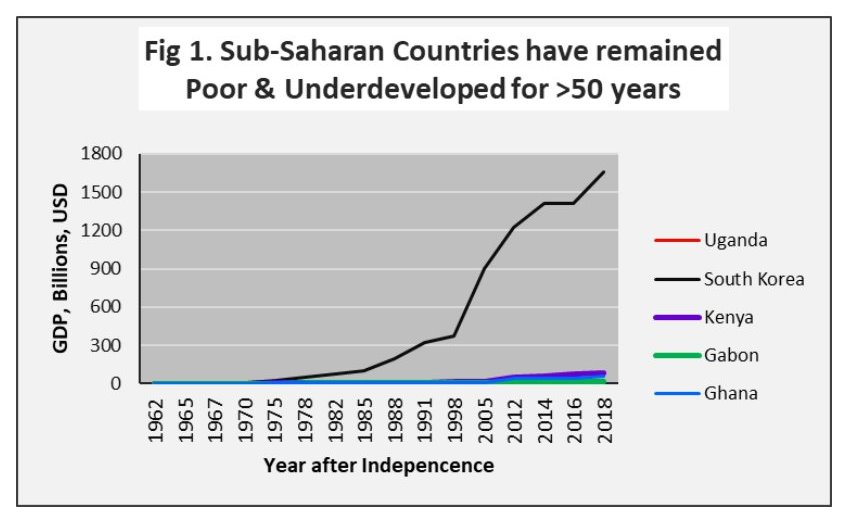
This mindset tragedy primarily explains why sub-Saharan countries, despite their potential, have not yet achieved broad, sustained socio-economic transformation (Figure 1).
Call to Action
EducationAfrica exists to address the foundational challenge described above, namely the need to intentionally grow development-enabling attitudes within education system. It recognises that transformation starts not with infrastructure or policies alone— but with the mindsets of learners.
EducationAfrica therefore offers a structured, age-specific approach to deliberately cultivate the attitudes required for development:
- Curiosity and innovation in early secondary students
- Self-belief and responsible decision-making in mid-secondary learners
- Productivity, discipline, and a value-creation mindset in senior students
- Work readiness, ethical wealth creation, and resilience in graduates
Through story-based learning resources, EducationAfrica integrates these attitudes into learners’ everyday educational experience from adolescence into adulthood—ensuring that academic knowledge is paired with the mindset necessary to apply it productively.
We call upon education policymakers, curriculum developers, school leaders, and teachers to intentionally integrate mindset development alongside academic instruction. By adopting and supporting initiatives such as EducationAfrica within schools, education systems will unlock the full developmental potential of learners.
In simple terms: EducationAfrica gives young Africans the “key” that unlocks their education — enabling them to innovate, compete, and transform their societies.
This is the pathway to move countries on the sub-continent from the peripheries of global development into meaningful participation and leadership – especially in the emerging multipolar world.
